

What’s Changing — A Snapshot
1. Introduction of Prior Authorization in Original Medicare
- Starting January 1, 2026, CMS will test a prior authorization (PA) process for select Traditional Medicare services in six states: New Jersey, Ohio, Oklahoma, Texas, Arizona, and Washington.
- This pilot, called the WISeR Model (Wasteful & Inappropriate Service Reduction), aims to reduce improper, low-value, or potentially fraudulent services.
2. Why Now?
- Medicare Advantage plans have long used PA to manage use and costs, whereas Original Medicare has not.
- Increased fraud (e.g. $1B in false claims for unnecessary skin grafts) prompted action.
- CMS plans to deploy AI and machine learning tools to support PA, with licensed clinicians making final decisions.
What’s Included – 17 Targeted Services
These services are deemed vulnerable to misuse and will require PA in the pilot:
- Various nerve stimulators (electrical, sacral, phrenic, deep brain, vagus, hypoglossal)
- Induced lesions of nerve tracts
- Epidural steroid injections (excluding facet joints)
- Percutaneous vertebral augmentation (for compression fractures)
- Cervical fusion
- Arthroscopic lavage/debridement of the knee for osteoarthritis
- Incontinence control devices
- Impotence treatment
- Percutaneous lumbar decompression
- Skin and tissue substitute for chronic non-healing wounds
Pilot Framework
- Duration & Scope: Runs from 2026 through 2031 across six states.
- Participation: Providers can choose pre-service PA or opt for retrospective medical review.
- Payment Model: Authorized PA vendors share in federal savings — potentially influencing review stringency.
- Limits: Emergency and inpatient only services are excluded.
Key Concerns & Criticism
- Delay Risks: Critics argue PA could slow needed care, as seen in Medicare Advantage criticisms.
- Political Skepticism: Both Democrats and Republicans express concerns it mirrors MA tactics:
- Rep. DelBene (D-WA): “baffling… instituting the same delay tactics in traditional Medicare.”
- Michael Baker (A.A.F.): warns “duplicative third party” and untested AI may increase administrative burdens and delays.
- Reddit voices reflect anxiety:
- “So, now some AI model will be blocking these treatments, after a full Medical Doctor has advised to receive them?”
- “It sounds like the insurance companies are trying to narrow the differences between Part B original Medicare and Advantage plans.”
Impact & Implications
Beneficiaries:
- PA may lead to delays or denials for specific procedures — especially those 17 targeted services.
- Strongly consider appealing PA denials — the process allows for it.
Providers:
- Expect new admin tasks — forms, documentation, PA submission.
- Retrospective audits pose risk: services provided without PA could go unpaid.
- PA may reduce unwarranted procedures (e.g., needless knee arthroscopy).
Payers & Policy:
- AI/ML aims to streamline review, but final decisions rest with licensed clinicians.
- CMS intends iterative expansion — added services and states could follow based on results.
What You Should Do
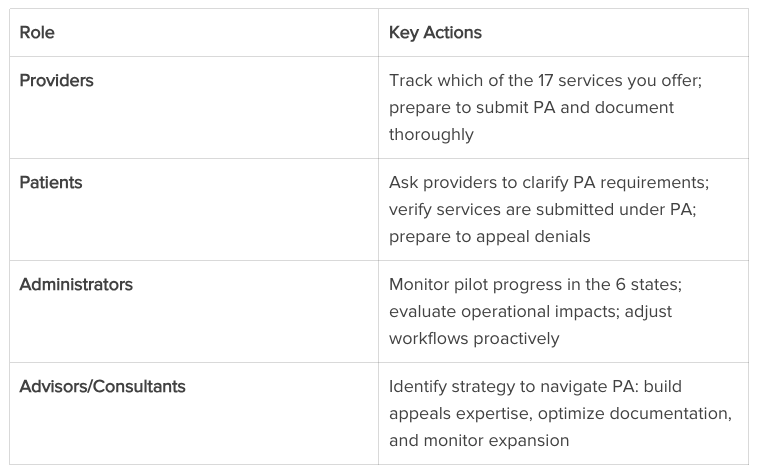
Bottom Line
Original Medicare is shifting toward a hybrid model blending traditional coverage with managed care tools like prior authorization. Costs and fraud control are the driving forces, but this comes with added complexity and risk of delay. For now, it’s a targeted pilot limited to specific services and states, but its outcome could reshape Medicare nationwide.
To read the full article, please refer to this link: https://www.kiplinger.com/retirement/medicare/prior-authorization-coming-to-traditional-medicare